


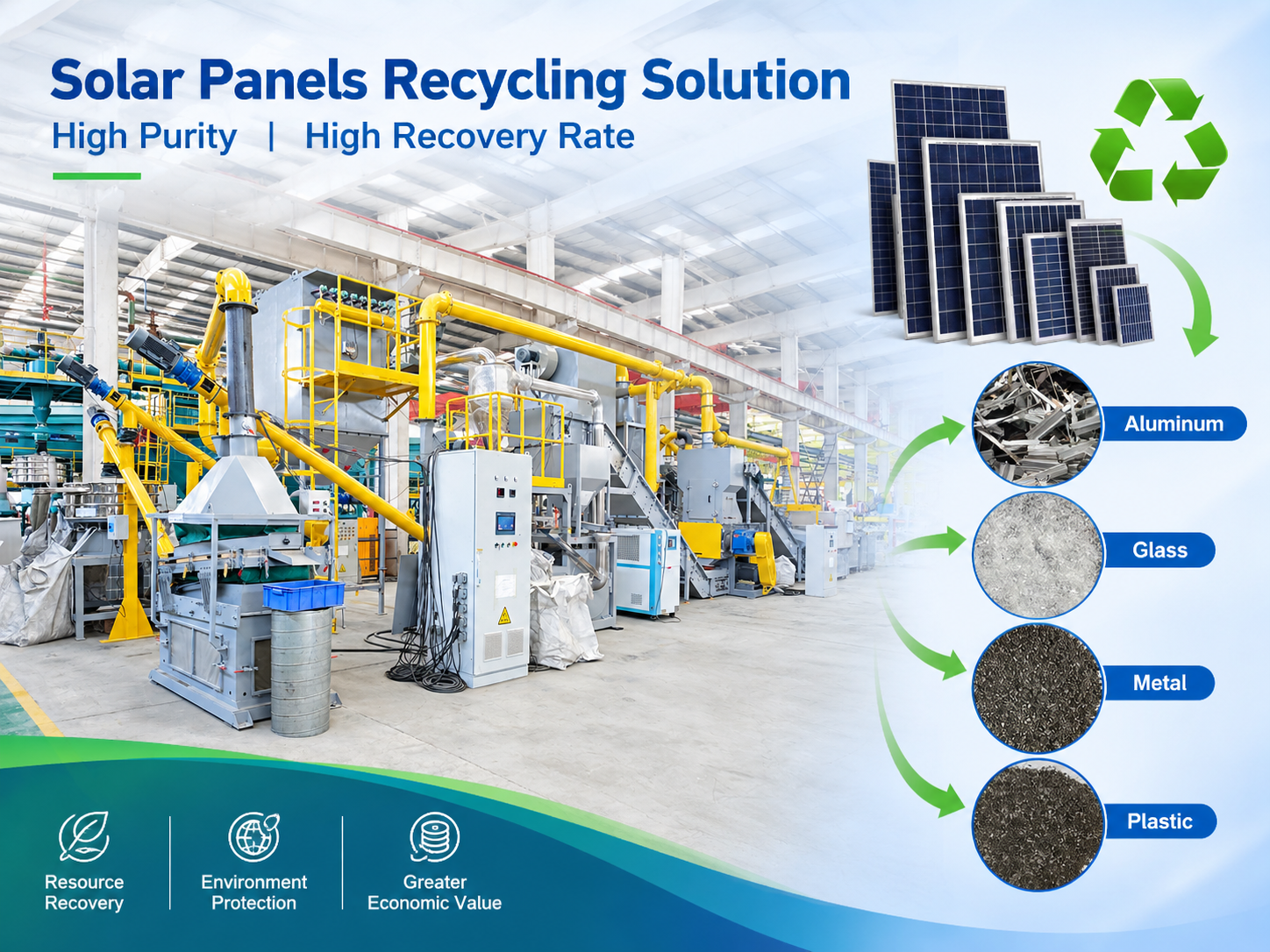
Waste Solar Panel Recycling System High Purity High Recovery Rate
As the global photovoltaic industry continues to expand, an increasing number of solar panels are becoming waste due to aging, physical damage, premature replacement, and solar farm upgrades. This has created a growing need for efficient waste solar panel recycling systems that can recover valuable resources while minimizing environmental impact. A well-designed recycling system can effectively separate glass, aluminum, copper, silicon, and other components from discarded PV panels, helping recycling plants achieve high material recovery rates and high-purity recycled products.
Where Does Waste Solar Panel Come From?
Waste solar panels mainly come from several sources:
- End-of-life photovoltaic panels: Most solar panels have a service life of around 20–30 years. After this period, their power generation efficiency gradually decreases.
- Damaged solar panels: Panels damaged during transportation, installation, severe weather, fire, or mechanical impact may no longer be suitable for operation.
- Solar farm upgrades: Large photovoltaic projects may replace older panels with newer and more efficient modules before the original panels reach the end of their designed life.
- Manufacturing waste: Defective panels, broken cells, production scraps, and rejected modules from PV factories can also enter the recycling stream.
As the global installed PV capacity continues to increase, effective solar panel recycling is becoming an important part of sustainable photovoltaic development.
Why Recycle Waste Solar Panels?
Waste solar panels contain large quantities of reusable materials. Simply sending them to landfills can waste valuable resources and create additional environmental pressure.
A complete solar panel recycling system can recover glass, aluminum frames, copper wires, junction boxes, silicon-containing materials, and other fractions. Recycling these materials reduces the demand for virgin raw materials and improves the resource efficiency of the photovoltaic industry.
For recycling companies, waste solar panels can also provide multiple revenue streams because different recovered materials can be sorted and sold according to their market value and quality.
How to Build a Waste Solar Panel Recycling System?
A complete recycling line should be designed according to the panel type, capacity, and required purity. A typical system can include the following stages:
- Panel preparation: Remove cables, junction boxes, and other accessible components.
- Aluminum frame removal: A frame dismantling machine separates the aluminum frame from the solar panel without unnecessary damage.
- Size reduction: A crusher or specialized shredder breaks the panel into manageable pieces.
- Glass separation: Screening and separation equipment removes and collects glass efficiently.
- Metal separation: Magnetic separators, eddy current separators, and other technologies can recover ferrous and non-ferrous metals.
- Fine separation: Advanced screening and air or density separation can further separate silicon, EVA, plastic, copper, and other fine fractions.
For plants with large processing requirements, PLC-controlled conveyors, dust collection systems, automatic feeding, and centralized control can improve continuous operation and production efficiency.
How to Achieve High Purity and High Recovery Rate?
A high purity high recovery rate solar panel recycling system requires more than simple crushing. The entire process must be carefully designed.
First, different panel structures, such as monocrystalline, polycrystalline, thin-film, and double-glass modules, should be evaluated separately. Second, frame and cable removal before crushing can reduce contamination and improve downstream sorting. Third, multi-stage crushing and screening should be used to control particle size.
Advanced separation technologies are also important. Magnetic separation can recover ferrous materials, while eddy current separation is suitable for non-ferrous metals such as aluminum and copper. Air separation, vibration screening, and density-based separation can improve the purity of glass, plastic, and other fractions.
A dust collection system is also necessary because fine particles generated during processing may affect product quality and working conditions.
What Are the Recovered Materials Used For?
The recovered materials from waste solar panels have many applications. Recycled glass can be used in glass products, construction materials, and other industrial applications. Aluminum frames can be remelted and used to manufacture new aluminum products. Copper wires can enter copper smelting and refining processes for reuse.
Recovered silicon-containing materials can potentially be processed for further industrial applications, depending on purity and the technology used. EVA and plastic fractions may be used as secondary materials or processed through appropriate recovery methods.
Therefore, a well-designed Waste Solar Panel Recycling System High Purity High Recovery Rate not only reduces photovoltaic waste but also transforms discarded solar panels into valuable secondary resources. By combining efficient dismantling, controlled size reduction, advanced sorting, and proper quality control, recycling companies can achieve higher purity, higher recovery rates, and a more economically sustainable solar panel recycling process.
Next: