


Solar Panel Recycling Technology
With the rapid development of renewable energy, millions of photovoltaic (PV) solar panels are being installed worldwide every year. As early-generation panels gradually reach the end of their service life, solar panel recycling technology has become an important global industry.
Waste solar panels contain valuable materials such as:
- Aluminum
- Glass
- Silicon
- Copper
- Silver
Professional recycling not only reduces environmental pollution but also recovers high-value materials for reuse in new industries.
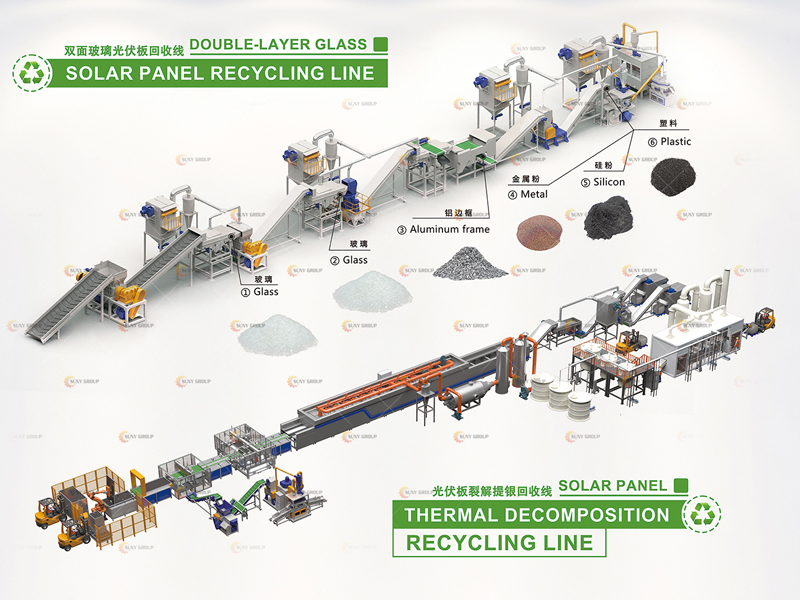
Currently, the two most common recycling technologies are:
- Physical recycling method
- Pyrolysis recycling method
Both technologies have different processes, advantages, and final recovered materials.
Main Composition of Solar Panels
Understanding solar panel structure helps determine suitable recycling methods.
A standard solar panel mainly includes:
- Aluminum frame
- Tempered glass
- EVA encapsulation film
- Silicon solar cells
- Copper ribbons
- Backsheet materials
Among these materials, glass and aluminum account for the largest proportion, while silver and silicon have high economic value.
Physical Recycling Method for Solar Panels
The physical method is one of the most widely used solar panel recycling technologies.
Main Recycling Process
The physical recycling process usually includes:
- Manual dismantling
- Aluminum frame removal
- Glass separation
- Crushing and shredding
- Grinding
- Airflow separation
- Electrostatic separation
This method mainly uses mechanical force to separate different materials without chemical reactions.
Advantages of Physical Recycling Method
Environmentally Friendly
The physical process produces less secondary pollution and avoids excessive chemical use.
Lower Operating Cost
Mechanical recycling systems consume relatively low energy and have lower maintenance costs.
High Automation
Modern recycling lines can achieve continuous automatic operation with high processing efficiency.
Suitable for Large-Scale Recycling
This method is ideal for processing large quantities of waste photovoltaic panels.
Final Recovered Materials from Physical Method
The physical recycling method mainly recovers:
- Aluminum frame
- Tempered glass
- Copper particles
- Silicon powder
- Mixed metal powder
The recovered glass and aluminum usually maintain high purity and can be directly reused.
However, silver recovery efficiency may be relatively lower compared with thermal treatment methods.
Pyrolysis Recycling Method for Solar Panels
The pyrolysis method uses high temperatures to decompose organic materials inside solar panels.
Main Recycling Process
Typical pyrolysis recycling steps include:
- Pre-dismantling
- Crushing
- High-temperature pyrolysis
- Organic material decomposition
- Metal separation
- Precious metal recovery
The pyrolysis furnace decomposes EVA film and backsheet materials under controlled temperatures.
Advantages of Pyrolysis Recycling Method
Higher Precious Metal Recovery
Pyrolysis improves the recovery rate of:
- Silver
- Copper
- Silicon
The thermal process exposes valuable materials more completely.
Better Separation Efficiency
Organic encapsulation materials are removed thoroughly, making metal separation easier.
Suitable for High-Value Panels
Pyrolysis is especially suitable for processing high-value photovoltaic modules with complex structures.
Improved Material Purity
Recovered silicon and metal materials usually have higher purity.
Final Recovered Materials from Pyrolysis Method
Pyrolysis recycling can recover:
- High-purity silicon
- Silver powder
- Copper
- Aluminum
- Glass
- Carbon residue
Compared with the physical method, pyrolysis produces cleaner and more separated precious metal materials.
However, the process requires higher energy consumption and stricter environmental control systems.
Difference Between Physical Method and Pyrolysis Method
Physical Recycling Method
Features
- Lower energy consumption
- Lower investment cost
- Simpler operation
- Suitable for large-scale recycling
Main Products
- Glass
- Aluminum
- Mixed metal powder
Pyrolysis Recycling Method
Features
- Higher precious metal recovery
- Better material purity
- More complex process
- Higher equipment cost
Main Products
- High-purity silicon
- Silver
- Copper
- Precious metal concentrates
How to Choose the Right Solar Panel Recycling Technology
The choice depends on several factors:
Raw Material Type
Different panel structures require different recycling processes.
Investment Budget
Physical recycling plants usually require lower investment than pyrolysis systems.
Final Product Requirements
If high-purity precious metal recovery is required, pyrolysis may be the better option.
Environmental Regulations
Modern recycling plants should include:
- Dust collection systems
- Exhaust gas treatment
- Environmental protection equipment
Future Trends of Solar Panel Recycling Industry
Global solar panel waste is expected to increase rapidly over the next decade. Advanced automation, AI sorting technology, and intelligent metal recovery systems are becoming major trends in the photovoltaic recycling industry.
Both physical recycling and pyrolysis recycling technologies will continue to play important roles in improving resource recovery and environmental sustainability.
For recycling companies and investors, choosing the right solar panel recycling technology is essential for building an efficient and profitable recycling business.