


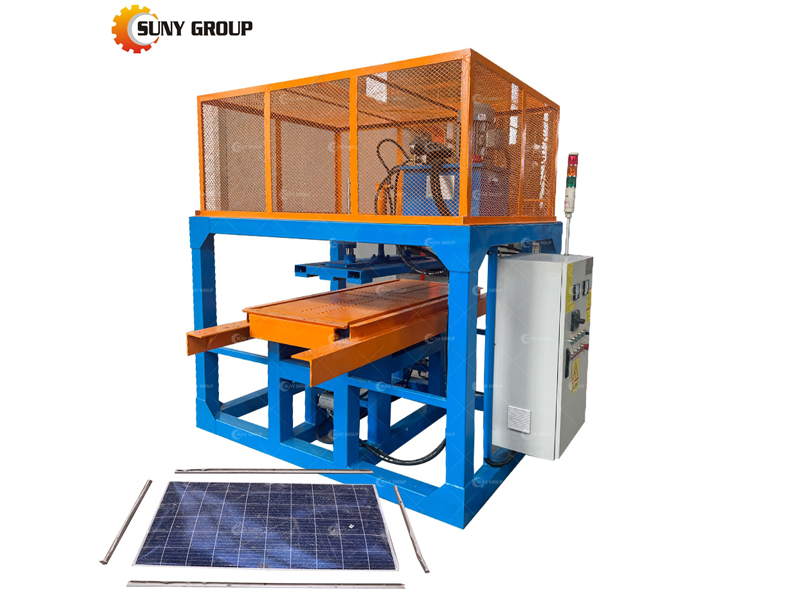
Scrap PV Module Disassemble Aluminum Frame Separator
With the rapid growth of solar photovoltaic installations, the number of scrap PV modules is increasing worldwide. Before further recycling, many waste solar panels need to be separated into aluminum frames, glass, silicon materials, junction boxes, and other components. Therefore, Scrap PV Module Disassemble Aluminum Frame Separator has become an important machine for PV recycling plants. It can improve dismantling efficiency, recover valuable aluminum, and reduce manual labor.
Why Should Scrap PV Modules Be Disassembled?
Most crystalline silicon PV modules are assembled with aluminum frames to provide mechanical protection and structural support. However, the aluminum frame is not suitable for subsequent crushing and material separation together with the panel.
Removing the aluminum frame first provides several important advantages:
- Higher aluminum recovery: The aluminum frame can be collected separately with relatively high purity.
- Improved recycling efficiency: Frame removal makes subsequent glass and PV material processing easier.
- Reduced equipment wear: Large aluminum frames can cause unnecessary impact and wear on shredders or crushers.
- Better material separation: Separating the frame before further processing helps improve the purity of recovered materials.
- Lower labor costs: A mechanical disassembly machine can replace much of the manual frame-removal work.
After dismantling, the recovered aluminum can enter the metal recycling system instead of being mixed with glass and other PV components.
How Does a PV Module Aluminum Frame Separator Work?
A PV module disassembly machine generally uses mechanical cutting, clamping, pressing, or pulling mechanisms to separate the aluminum frame from the solar panel.
The basic working process is:
PV Module Feeding → Positioning → Frame Separation → Aluminum Collection → Panel Discharge
First, the operator places the scrap PV module onto the feeding or positioning platform. The module is then fixed securely. The machine applies controlled mechanical force to the aluminum frame and separates it from the panel along the frame edge.
Depending on the equipment design, some machines use hydraulic cylinders, mechanical cutters, or specialized frame-removing tools. The removed aluminum frame is discharged separately, while the remaining PV panel can be sent to subsequent glass separation, crushing, or sorting equipment.
Semi-Automatic or Fully Automatic: Which Is Better?
Choosing between a semi-automatic PV frame disassembly machine and a fully automatic system depends mainly on processing capacity, labor availability, budget, and plant layout.
Semi-Automatic PV Frame Disassembly Machine
A semi-automatic machine usually requires workers to load and position PV modules manually.
It is suitable for:
- Small and medium-sized recycling businesses
- Lower or moderate processing capacities
- Plants with sufficient labor
- Customers with limited investment budgets
- Recycling projects that need flexible operation
The main advantages are relatively low investment, simple operation, and easier maintenance.
Fully Automatic PV Frame Separator
A fully automatic system can integrate feeding, positioning, frame removal, conveying, and material collection.
It is more suitable for:
- Large-scale PV recycling plants
- High-volume scrap solar panel processing
- Customers looking to reduce labor costs
- Continuous industrial production
- Automated recycling lines
Although the initial investment is higher, automation can provide higher processing efficiency and more stable production when large quantities of scrap PV modules need to be processed.
How to Choose the Right PV Module Disassembly Machine?
Customers should consider the following factors before purchasing a Scrap PV Module Disassemble Aluminum Frame Separator:
- Processing capacity: Determine the required modules or tons per hour.
- PV module dimensions: Check the maximum and minimum panel sizes that the machine can process.
- Module type: Consider whether the input consists mainly of standard crystalline silicon modules or mixed PV panels.
- Automation level: Choose semi-automatic equipment for flexible small-scale production or fully automatic equipment for high-volume processing.
- Labor costs: Higher labor costs can make automatic equipment more attractive.
- Available space: Check the machine dimensions and required feeding and discharge areas.
- Downstream recycling process: Make sure the frame separator can connect efficiently with glass, junction box, cable, and PV material recycling equipment.
- Investment budget: Compare equipment cost with expected capacity, labor savings, aluminum recovery, and long-term operating costs.
What Can Recovered Aluminum Frames Be Used For?
The aluminum frame is one of the most valuable components recovered from scrap PV modules. After separation, the aluminum frames can be collected, sorted, and sent to aluminum recycling facilities.
Recycled aluminum can be used to manufacture:
- New aluminum profiles
- Construction materials
- Automotive components
- Industrial products
- Solar mounting structures
- Aluminum sheets and other metal products
Because aluminum can be recycled repeatedly while retaining much of its material value, efficient PV module aluminum frame separation can significantly improve the economic benefits of solar panel recycling.
Scrap PV Module Disassemble Aluminum Frame Separator is an important first-stage machine for efficient solar panel recycling. Removing the aluminum frame before further processing improves material separation, protects downstream equipment, reduces labor requirements, and allows valuable aluminum to be recovered separately. Semi-automatic machines are generally suitable for small and medium-scale operations, while fully automatic systems are better for high-capacity industrial recycling plants. By considering capacity, module size, automation, labor costs, budget, and downstream processes, customers can select the most suitable PV module frame disassembly solution for their recycling business.
Next: