


PV Recycling & Resource Recovery Facility
As solar energy continues to expand worldwide, more photovoltaic (PV) panels are reaching the end of their service life or becoming damaged and unsuitable for further use. This has created growing demand for efficient PV Recycling & Resource Recovery Facilities. By using advanced dismantling, separation, and recovery technologies, these facilities can turn discarded PV modules into valuable secondary materials, including glass, aluminum, copper, silicon, silver, and other recoverable components. Proper PV recycling not only reduces the amount of solar panel waste sent to landfills but also helps conserve natural resources and promote a more sustainable and circular solar energy industry.
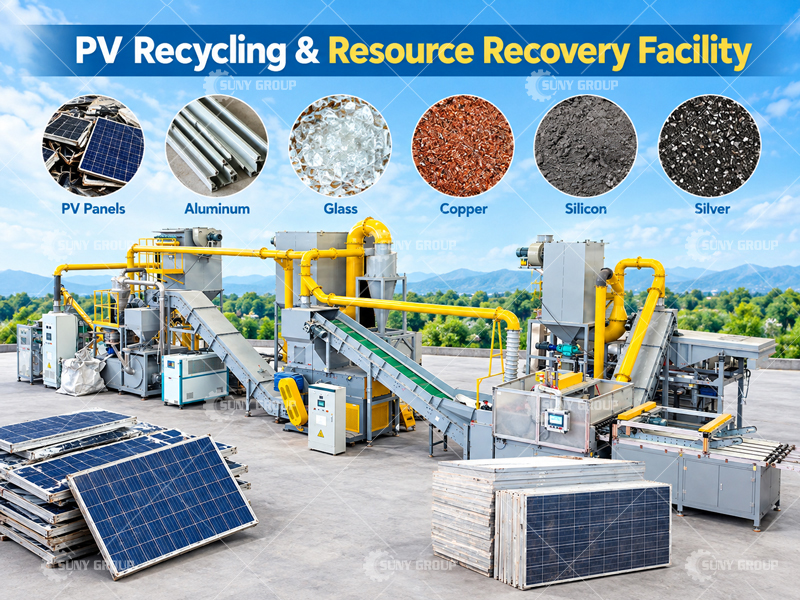
What Resources Can Be Recovered from PV Modules?
Most conventional crystalline-silicon PV modules contain a large proportion of glass and aluminum, together with smaller quantities of silicon, copper, silver, polymers, and other materials. Typical recoverable resources include:
- PV Glass – Glass is usually the largest material fraction in a crystalline-silicon module. Recovered glass can be processed into cullet and supplied to glass manufacturers or used in construction-related products. Research has demonstrated the use of recovered PV glass in building components.
- Aluminum Frames – Aluminum frames can normally be removed before crushing and shredding. Recovered aluminum scrap can enter conventional aluminum recycling streams and be remelted into new aluminum products.
- Silicon – Silicon can be recovered from solar cells after delamination, crushing, separation, and further purification. High-purity recovered silicon has the potential to be processed into silicon feedstock, wafers, or other applications. Fraunhofer research has demonstrated wafers and solar cells produced using recycled silicon.
- Copper – Copper is mainly found in ribbons, wires, and electrical connections. After mechanical separation, copper can be recovered and supplied to copper recycling facilities for further refining.
- Silver and Other Metals – Solar cells contain small quantities of valuable metals such as silver. Advanced physical, thermal, and chemical processes can concentrate or recover these metals for further refining.
- Polymers – EVA encapsulant, backsheets, and other plastics can also be separated during advanced PV recycling processes, although their recovery routes and end uses depend on composition and purity.
What Types of PV Recycling Facilities Are Available?
PV Recycling Facility can be designed according to module type, processing capacity, target recovery rate, and the required purity of final products.
- Mechanical PV Recycling Plant: Uses de-framing, dismantling, crushing, screening, air separation, magnetic separation, and electrostatic separation. This is suitable for commercial processing of many crystalline-silicon modules.
- Thermal Recycling Facility: Uses controlled heating or thermal treatment to weaken or remove EVA and other encapsulation materials.
- Chemical Recovery Plant: Uses controlled chemical treatment to recover higher-value materials such as silicon and silver.
- Hybrid PV Recycling Plant: Combines mechanical, thermal, and chemical technologies to achieve higher material purity and recovery rates.
Mechanical recycling remains an important commercial approach for crystalline-silicon PV modules, while thermal and chemical combinations can provide higher recovery rates or purity for certain materials.
How to Build a PV Recycling Plant?
Building a PV Recycling Plant should begin with a detailed analysis of incoming PV module types and local waste supply. A practical plant normally includes the following steps:
1. Module Collection and Inspection
Collect end-of-life and damaged PV modules and inspect them for module type, condition, glass structure, and hazardous or special components.
2. De-framing and Dismantling
Remove aluminum frames, junction boxes, cables, and other easily detachable components before further processing. This reduces the load on downstream equipment.
3. Glass and Laminate Separation
Separate the glass from the encapsulated solar-cell layers using mechanical cutting, thermal delamination, or other suitable technology.
4. Crushing and Screening
Crush the remaining laminate and classify the material according to particle size.
5. Material Separation
Use screening, air classification, electrostatic separation, and other technologies to separate glass, silicon, plastics, copper, and metal-rich fractions. Automated sorting and selective delamination are important for improving recovery efficiency.
6. Refining and Quality Control
High-value fractions such as silicon, silver, and copper can be sent to downstream refining processes. Final products should be tested for purity before being sold as secondary raw materials.
Application Value of Recovered PV Resources
The economic value of a PV Recycling & Resource Recovery Facility depends heavily on material purity, processing efficiency, transportation, local markets, and downstream refining costs.
Recovered aluminum can be remelted into new aluminum products, while copper can return to wire, cable, electrical, and metal manufacturing. Glass can be used as secondary raw material for glass products and selected construction applications. Silicon has greater potential value when sufficiently purified because it can potentially return to the photovoltaic supply chain. Silver can be recovered for precious-metal refining and industrial applications.
Therefore, a well-designed PV Recycling & Resource Recovery Facility should not focus only on recovering the largest material fraction. Instead, it should combine high recovery efficiency, material purity, automated separation, dust control, and suitable downstream markets. By turning discarded PV modules into reusable glass, aluminum, copper, silicon, silver, and other resources, a modern PV recycling plant can create a practical pathway toward a more circular photovoltaic industry.
Next: