


Semi-Automatic Mechanical Separator Plant & Pyrolysis Plant for PV Module Recycling
As the first generation of solar panels reaches the end of its 20–30-year service life, the volume of discarded photovoltaic (PV) modules is increasing rapidly worldwide. Recycling PV modules not only reduces environmental waste but also recovers valuable materials that can be reused in manufacturing and industrial applications.
The main recyclable materials in PV modules include:
- Aluminum frames
- Tempered glass
- Copper cables
- Silicon wafers
- Silver
- EVA (Ethylene Vinyl Acetate)
- Backsheet materials
- Junction boxes
Recovering these materials helps reduce dependence on raw material mining and supports the circular economy in the renewable energy industry.
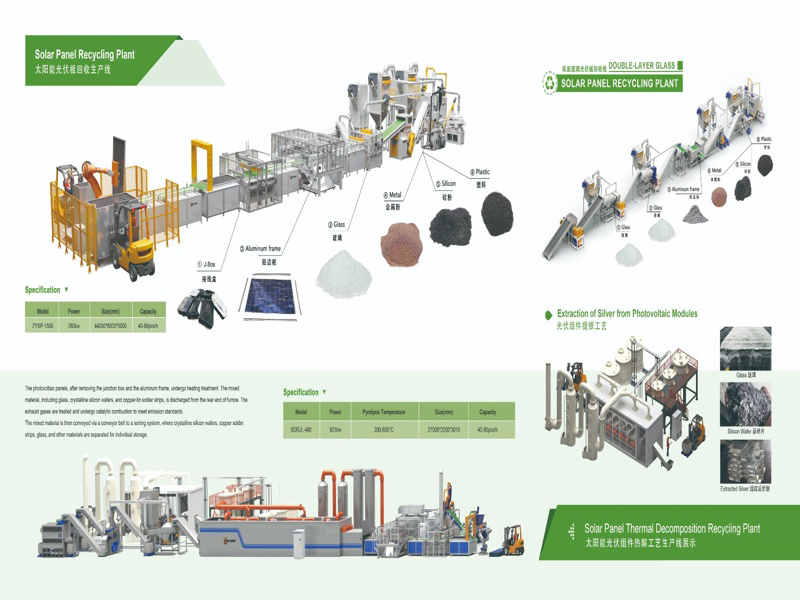
Method 1: Semi-Automatic Mechanical Separator Plant
What Is a Mechanical Separator Plant?
A semi-automatic mechanical separator plant uses physical processing methods to dismantle and separate PV modules without high-temperature treatment. This method is widely used due to its lower investment cost and environmentally friendly operation.
Typical Recycling Process
- Manual removal of aluminum frames and junction boxes
- Glass separation machine removes tempered glass
- Crushing and shredding of solar panels
- Grinding and milling process
- Airflow separation
- Magnetic separation
- Electrostatic separation
- Collection of silicon powder and metal concentrates
Advantages
- Lower equipment investment
- Lower energy consumption
- Environmentally friendly process
- Simple operation and maintenance
- Suitable for small and medium recycling facilities
Disadvantages
- EVA encapsulation is difficult to remove completely
- Silver recovery rate may be lower
- Material purity is generally lower than thermal treatment methods
- Some mixed materials require further refining
Method 2: Pyrolysis Plant for PV Module Recycling
What Is a Pyrolysis Recycling Plant?
A pyrolysis plant uses controlled high-temperature treatment in an oxygen-free environment to decompose organic materials such as EVA and backsheet layers. This process exposes valuable metals and silicon cells for more efficient recovery.
Typical Recycling Process
- Removal of aluminum frames and junction boxes
- Feeding modules into the pyrolysis furnace
- Thermal decomposition of EVA and polymer layers
- Cooling and discharge of treated materials
- Crushing and separation
- Metal recovery and purification
Advantages
- Higher recovery efficiency
- Better separation of silicon cells
- Improved silver recovery rates
- Higher material purity
- Suitable for large-scale industrial recycling
Disadvantages
- Higher initial investment cost
- Increased energy consumption
- Requires advanced emission control systems
- More complex operation and maintenance
Mechanical Separation vs. Pyrolysis: Which Is Better?
| Factor | Mechanical Separator Plant | Pyrolysis Plant |
|---|---|---|
| Investment Cost | Lower | Higher |
| Energy Consumption | Lower | Higher |
| Recovery Purity | Medium | High |
| Silver Recovery | Medium | High |
| Environmental Control | Simpler | More Complex |
| Operating Cost | Lower | Higher |
| Production Capacity | Medium | Large Scale |
| Automation Level | Semi-Automatic | High |
For investors with limited budgets, a semi-automatic mechanical separator plant provides an economical solution. For large recycling facilities seeking maximum recovery efficiency and material purity, pyrolysis technology offers superior performance.
Recovered Materials and Their Applications
Glass
Recovered solar glass can be used in:
- New glass manufacturing
- Construction materials
- Fiberglass production
Aluminum
Recycled aluminum frames are widely used in:
- Construction industries
- Automotive manufacturing
- New solar panel frames
Copper
Recovered copper is applied in:
- Electrical cables
- Electronic products
- Industrial equipment
Silicon
Purified silicon can be reused in:
- Solar cell manufacturing
- Semiconductor industries
- Metallurgical applications
Silver
Recovered silver is valuable for:
- Electronics production
- Electrical contacts
- Precious metal refining
PV module recycling is becoming a critical industry as global solar installations continue to grow. Both semi-automatic mechanical separator plants and pyrolysis recycling plants provide effective solutions for recovering valuable materials from end-of-life solar panels. Mechanical separation offers lower investment and operating costs, while pyrolysis technology delivers higher recovery rates and material purity. Choosing the right recycling method depends on production capacity, investment budget, and desired recovery efficiency. By adopting advanced PV module recycling technologies, businesses can generate economic returns while supporting sustainable resource recovery and environmental protection.