


Solar Panel Recycling Equipment Price
As global solar installations continue to grow, the demand for solar panel recycling equipment price and solutions is rising rapidly. Understanding panel types, recycling machines, and cost factors is essential for investors and recycling businesses.
1. Types of Solar Panels
Before recycling, it’s important to understand the main categories of solar panels:
- Monocrystalline panels
High efficiency, made from single-crystal silicon, widely used in residential and commercial projects. - Polycrystalline panels
Lower cost, slightly lower efficiency, common in large-scale solar farms. - Thin-film panels
Lightweight and flexible, include CdTe and CIGS technologies, requiring specialized recycling processes.
2. Solar Panel Recycling Equipment List
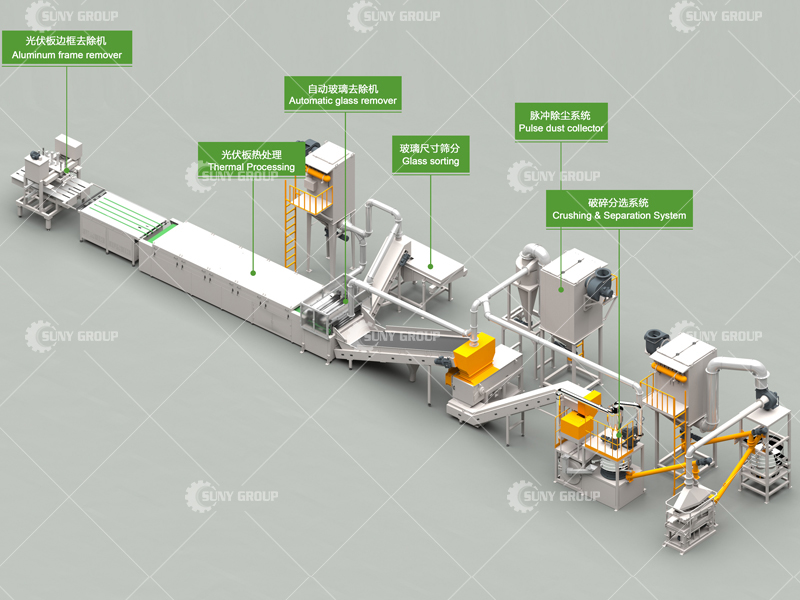
A complete solar panel recycling plant typically includes the following machines:
- Frame removal machine – separates aluminum frames
- Glass removal machine – detaches tempered glass layer
- Thermal or heating system – removes EVA adhesive
- Crushing and shredding machine – breaks panels into smaller particles
- Separation system – separates silicon, metals, and plastics
- Dust collection system – ensures environmental compliance
These machines can be configured into a fully automated recycling line depending on capacity.
3. Solar Panel Recycling Equipment Price
The solar panel recycling equipment price varies widely depending on scale and automation level:
- Small-scale plant: $50,000 – $100,000
- Medium-scale plant: $100,000 – $300,000
- Fully automatic plant: $300,000+
4. Key Factors Affecting Price
Several factors influence the total investment cost:
- Capacity (kg/h or ton/h) – higher capacity increases cost
- Automation level – manual vs fully automatic systems
- Technology used – thermal, mechanical, or chemical processes
- Material compatibility – thin-film recycling requires advanced systems
- Environmental protection requirements – dust and emission control systems
- Supplier and country of origin
5. Recycled Materials and Applications
After recycling, valuable materials can be recovered:
- Glass (70–80%) – reused in construction and new panels
- Aluminum frames – recycled into industrial products
- Silicon – reused in solar or electronics industries
- Copper and silver – valuable metals for electrical applications
- Plastics – used in fuel or secondary materials
These recycled materials have strong market demand, improving project profitability.
Investing in a solar panel recycling plant is both environmentally and economically beneficial. By understanding solar panel types, recycling equipment, price ranges, and output materials, businesses can make informed decisions and enter the growing renewable recycling industry with confidence.