


Solar Panel Recycling Plant Cost in Middle East
The Middle East is becoming one of the world’s fastest-growing solar energy markets. Countries such as Saudi Arabia, United Arab Emirates, Oman, and Qatar are investing heavily in large-scale photovoltaic (PV) projects to diversify their energy sources and achieve carbon reduction goals. As the first generation of solar panels gradually reaches the end of its service life, the demand for solar panel recycling plants is expected to increase significantly.
This creates a valuable business opportunity for investors interested in establishing a solar panel recycling plant in the Middle East.
Why Is the Middle East Solar Panel Recycling Market Growing?
Several factors are driving the rapid growth of PV recycling in the region:
1. Massive Solar Power Expansion
The Middle East has some of the highest solar irradiation levels in the world, making solar energy highly attractive. Thousands of megawatts of PV projects are being installed annually.
2. Aging Solar Panels
Most solar panels have a lifespan of 25–30 years. Early installations are beginning to generate significant volumes of end-of-life modules.
3. Environmental Regulations
Governments are introducing sustainability policies that encourage proper recycling and waste management of solar modules.
4. Valuable Recoverable Materials
Solar panels contain high-value materials that can be recovered and reused, creating additional revenue streams.
Is a Solar Panel Recycling Plant Profitable in the Middle East?
The answer is yes, especially as recycling volumes continue to grow.
Main Revenue Sources
- Processing fees from solar farm operators
- Sale of recovered aluminum frames
- Sale of glass materials
- Recovery of copper cables
- Recovery of silver-containing materials
- Silicon recovery
- Government recycling incentives (where applicable)
Key Profit Advantages
- Increasing availability of waste PV panels
- Growing demand for recycled materials
- Reduced dependence on imported raw materials
- Long-term sustainability benefits
A medium-scale recycling facility processing 1–2 tons per hour can generate attractive returns once a stable feedstock supply is established.
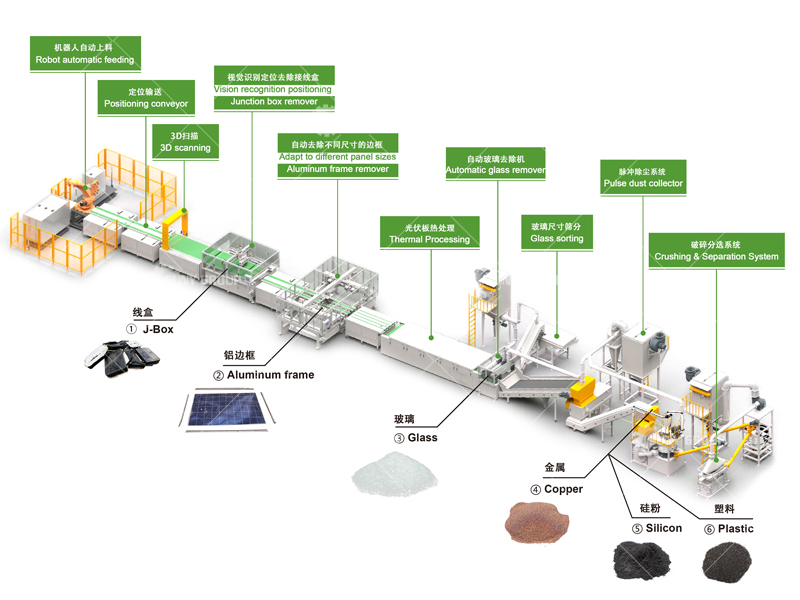
Solar Panel Recycling Plant Configuration
A complete solar panel recycling line typically includes the following equipment:
1. Solar Panel Dismantling Machine
Functions:
- Removes aluminum frames
- Separates junction boxes
- Reduces manual labor
- Improves processing efficiency
2. Conveyor Feeding System
Functions:
- Continuous material transportation
- Automated production operation
- Stable feeding process
3. Crushing Machine
Functions:
- Breaks solar panels into smaller pieces
- Releases glass and encapsulated materials
- Prepares materials for separation
4. Grinding System
Functions:
- Further reduces material size
- Enhances separation efficiency
- Improves material liberation
5. Air Separation System
Functions:
- Separates lightweight and heavy materials
- Removes plastic films and backsheet components
6. Electrostatic Separator
Functions:
- Separates conductive and non-conductive materials
- Recovers copper and metallic fractions
7. Dust Collection System
Functions:
- Environmental protection
- Cleaner production environment
- Reduced material loss
8. Intelligent Control System
Functions:
- Automated operation
- Lower labor requirements
- Real-time monitoring
Solar Panel Recycling Plant Cost in the Middle East
The investment depends on plant capacity and automation level.
| Plant Capacity | Estimated Cost |
|---|---|
| 300–500 kg/h | USD 80,000–150,000 |
| 1 ton/h | USD 150,000–300,000 |
| 2 tons/h | USD 300,000–600,000 |
| 3–5 tons/h | USD 600,000–1,200,000+ |
Factors Affecting Cost
- Processing capacity
- Automation level
- Recovery efficiency requirements
- Local labor costs
- Installation and transportation expenses
- Environmental compliance systems
Investors should select equipment according to expected feedstock volumes and future expansion plans.
Recycled Materials from Solar Panels
A modern recycling plant can recover multiple valuable materials.
Aluminum
Recovered from panel frames.
Applications:
- Construction materials
- Automotive parts
- Industrial manufacturing
Glass
Typically accounts for 65–75% of panel weight.
Applications:
- Glass manufacturing
- Building materials
- Fiberglass production
Copper
Recovered from cables and junction boxes.
Applications:
- Electrical wiring
- Electronics manufacturing
- Renewable energy equipment
Silicon
Recovered from solar cells.
Applications:
- New solar products
- Semiconductor industries
- Industrial silicon products
Silver
A small percentage but highly valuable.
Applications:
- Electronics
- Electrical contacts
- Industrial manufacturing
Plastic Materials
Recovered from backsheet and encapsulation layers.
Applications:
- Plastic products
- Composite materials
- Energy recovery
Advantages of Building a Solar Panel Recycling Plant in the Middle East
Key Benefits
- Growing solar energy industry
- Increasing volume of end-of-life PV panels
- High-value material recovery
- Strong long-term market potential
- Environmental compliance opportunities
- Contribution to circular economy development
For investors seeking a future-oriented recycling business, a solar panel recycling plant in the Middle East offers a combination of environmental value and strong commercial potential.
As solar energy installations continue to expand across the Middle East, solar panel recycling will become an essential industry. A properly designed recycling plant can recover aluminum, glass, copper, silicon, silver, and plastics while generating sustainable profits. With suitable equipment configuration, efficient recovery technology, and growing regional demand, investing in a solar panel recycling plant represents a promising opportunity for businesses looking to enter the renewable energy recycling sector.