


Recycling Plant of Solar Panels
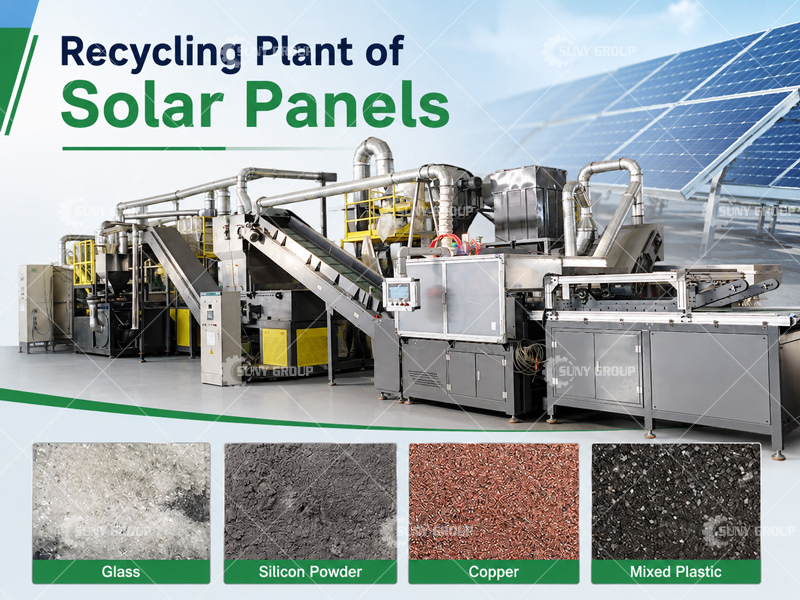
With the rapid growth of solar photovoltaic installations worldwide, the number of end-of-life PV modules is increasing. A recycling plant of solar panels provides an effective solution for recovering valuable materials and reducing solar panel waste. However, different solar panels have different structures and material compositions, so the equipment and process used in a recycling plant of solar panels should be selected according to the type of PV module.
What Types of Solar Panels Are There?
Before building a recycling plant of solar panels, it is important to understand the main types of solar panels currently used in the market.
1. Monocrystalline Solar Panels
Monocrystalline silicon panels are widely used in residential, commercial and utility-scale solar projects. Their main materials include:
- Tempered glass
- Aluminum frame
- Silicon solar cells
- Copper ribbons and cables
- EVA encapsulant
- Backsheet
- Junction box
A recycling plant of solar panels for monocrystalline modules mainly focuses on separating glass, aluminum, copper, silicon and polymer materials.
2. Polycrystalline Solar Panels
Polycrystalline panels also use silicon cells and have a structure similar to monocrystalline panels. Therefore, one recycling plant of solar panels can usually process both monocrystalline and polycrystalline modules.
The basic recycling process includes frame removal, junction-box removal, glass separation, crushing, grinding, screening and material separation.
3. Thin-Film Solar Panels
Thin-film solar panels are different from crystalline-silicon panels because their photovoltaic materials are deposited directly onto a substrate. Common types include CdTe and CIGS thin-film panels.
Because their semiconductor materials are different, a recycling plant of solar panels for thin-film modules requires specialized separation and recovery technology.
How Are Solar Panel Recycling Machines Different?
The biggest difference between solar panel recycling machines is their treatment method for the panel structure and valuable materials.
For crystalline-silicon panels, a typical recycling plant of solar panels can include:
- Solar panel frame removing machine – removes aluminum frames efficiently.
- Junction box removing machine – separates junction boxes and cables.
- Glass separation machine – separates the glass from the laminated PV layer.
- Solar panel crusher – reduces the size of remaining materials.
- Hammer mill or grinding machine – liberates silicon, copper and other materials.
- Magnetic separator – removes ferrous metals.
- Eddy current separator – separates non-ferrous metals.
- Air separator – separates lightweight plastics and other fractions.
- Vibrating screen – classifies materials according to particle size.
- Dust collection system – controls dust generated during crushing and grinding.
For thin-film modules, a recycling plant of solar panels may require additional specialized processes for recovering semiconductor materials such as cadmium, tellurium, indium, gallium and selenium.
Which Recycling Plant of Solar Panels Should You Build?
The plant configuration should match the incoming solar panel type.
Monocrystalline and Polycrystalline Panels
For these panels, a recycling plant of solar panels based mainly on mechanical separation is suitable.
Process:
Frame Removal → Junction Box Removal → Glass Separation → Crushing → Grinding → Screening → Separation → Collection
The final products may include:
- Recycled glass
- Aluminum
- Copper
- Silicon-rich material
- Plastic and EVA fractions
- Precious-metal-containing fractions
CdTe Thin-Film Panels
A specialized recycling plant of solar panels is recommended for CdTe modules. Besides glass and metals, the plant should focus on recovering cadmium and tellurium from the semiconductor layer.
CIGS Thin-Film Panels
For CIGS modules, a specialized recycling plant of solar panels can combine mechanical processing with advanced chemical or hydrometallurgical recovery. Potential recovered materials include glass, copper, indium, gallium and selenium.
What Are the Final Products of a Recycling Plant of Solar Panels?
The final output depends on the panel type and equipment configuration. A modern recycling plant of solar panels can potentially produce:
- Glass: used in glass manufacturing and construction materials.
- Aluminum: reused for metal products and new frames.
- Copper: used for electrical cables and copper products.
- Silicon: potentially processed for new material applications.
- Silver: recovered from valuable PV cell fractions.
- Polymer/EVA: processed into suitable secondary material or energy-recovery streams.
- CdTe materials: recovered from certain thin-film modules.
- Indium, gallium and selenium: potentially recovered from CIGS modules.
How to Choose a Recycling Plant of Solar Panels?
When selecting a recycling plant of solar panels, investors should consider:
- Type of solar panels.
- Processing capacity.
- Required recovery rate.
- Final product purity.
- Degree of automation.
- Equipment investment and operating cost.
- Dust and environmental-control requirements.
- Availability of waste PV modules.
- Local recycling regulations.
- Future expansion requirements.
In conclusion, there is no single configuration suitable for every PV module. A recycling plant of solar panels for monocrystalline and polycrystalline modules can mainly use mechanical separation, while thin-film panels require more specialized recovery processes. Choosing the correct recycling plant of solar panels according to the incoming materials is the key to achieving efficient recycling, high-value material recovery and stable long-term operation.
Next: