


Photovoltaic Panel Recycling Facility
As the global photovoltaic industry continues to expand, an increasing number of solar panels are reaching the end of their service life. This creates a growing demand for an efficient photovoltaic panel recycling facility. Recycling waste photovoltaic panels not only reduces the amount of solar waste sent to landfills but also recovers valuable materials such as glass, aluminum, silicon, copper and silver. A properly designed photovoltaic panel recycling facility can turn end-of-life PV modules into valuable secondary raw materials for different industries.
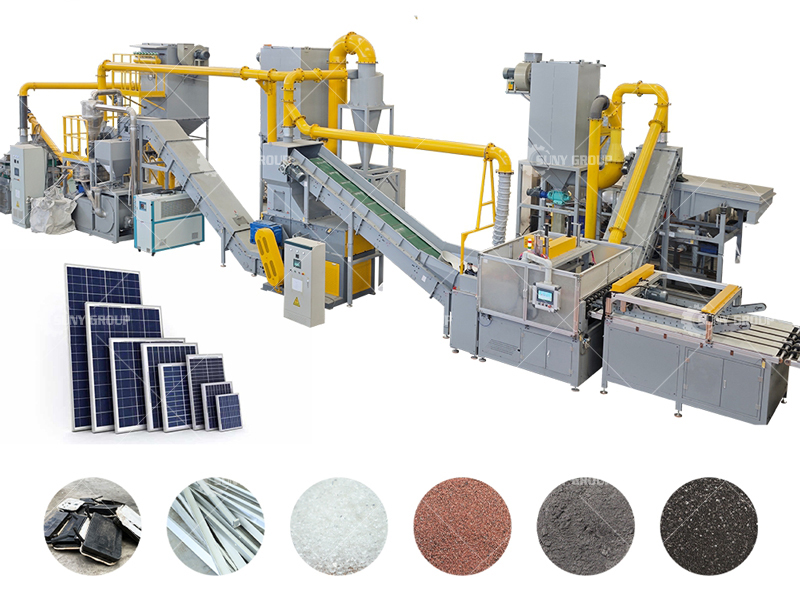
Why Should Photovoltaic Panels Be Recycled?
Photovoltaic panels are designed for long-term outdoor operation, but damaged, defective and end-of-life modules eventually need proper treatment. Landfilling whole panels wastes valuable resources and may create environmental management concerns because some PV technologies can contain metals such as lead, cadmium or other specialty materials.
More importantly, a large proportion of a crystalline-silicon PV panel consists of recyclable materials. Glass accounts for most of the panel weight, while aluminum, copper, silicon and smaller quantities of silver also have economic value. Recycling these materials reduces the need for virgin raw materials and supports a circular economy.
What Components Can Be Recycled?
A typical crystalline-silicon photovoltaic panel contains several recyclable components:
- Glass – The largest material fraction and one of the easiest materials to recycle.
- Aluminum frame – Can be directly recovered after frame dismantling and reused in aluminum products.
- Copper wires and ribbons – Valuable conductive materials suitable for copper recycling.
- Silicon solar cells – Can be recovered and further processed for silicon reuse.
- Silver – Present in small quantities in cell conductors but has high economic value.
- Plastics and EVA – Encapsulation and backsheet materials can be separated through mechanical or thermal processes.
- Junction boxes and cables – Can be separately recovered and processed as electronic or cable waste.
The exact recovery route depends on whether the incoming panels are crystalline-silicon, thin-film or another PV technology.
What Equipment Is Needed for a Photovoltaic Panel Recycling Facility?
A complete photovoltaic panel recycling plant can combine mechanical, thermal and, when high-purity recovery is required, chemical separation technologies.
1. PV Panel Dismantling Machine
The first step is usually removing the aluminum frame, junction box and external cables. An automatic or semi-automatic dismantling machine can improve processing efficiency while keeping the aluminum frame relatively clean.
2. Glass Removal or Delamination Machine
After frame removal, the glass must be separated from EVA, silicon cells and other laminated materials. Mechanical, thermal or emerging laser-based delamination technologies can be selected according to the required product purity.
3. Shredder and Crusher
The remaining PV laminate can be processed by a solar panel shredder and crusher to reduce particle size and liberate glass, silicon, metals and polymers. Mechanical recycling remains one of the most commercially important approaches for crystalline-silicon modules.
4. Grinding and Screening System
A fine grinding machine and vibrating screen can further reduce and classify the material according to particle size. This improves subsequent separation efficiency.
5. Magnetic, Air and Density Separation Equipment
Magnetic separators can remove ferrous impurities, while air separators, density separators or electrostatic separators can separate lightweight plastics from heavier glass and metal fractions. Modern systems may combine several sorting technologies to improve material purity.
6. Thermal or Chemical Recovery System
If the goal is to recover higher-purity silicon, silver and other valuable metals, a photovoltaic panel recycling facility may add thermal delamination, leaching, filtration, precipitation or electrochemical recovery equipment. These advanced processes can achieve higher purity but require greater investment and more sophisticated environmental controls.
What Materials Can Be Recovered?
A well-designed photovoltaic panel recycling facility can produce several valuable output streams, including:
- Recycled glass
- Aluminum frames
- Copper wires and copper granules
- Silicon-rich powder or recovered silicon
- Silver-bearing material
- Plastic and polymer fractions
- Junction boxes and electronic components
The recovered glass can be used in construction materials, glass manufacturing and other industrial products. Aluminum can return to metal manufacturing, while recovered copper can be used for electrical products, cables and other copper applications. Silicon can potentially be further purified for industrial or photovoltaic-related applications, depending on its quality. Research has demonstrated recovery of aluminum, copper, silver, silicon and glass from end-of-life PV modules.
How to Choose a Photovoltaic Panel Recycling Facility?
When selecting equipment, investors should consider panel type, processing capacity, required recovery rate, final material purity, labor requirements, energy consumption and environmental protection systems.
For large-scale commercial projects, an integrated system combining dismantling, glass separation, shredding, grinding, screening and sorting can provide efficient bulk material recovery. If the target is high-purity silicon and precious-metal recovery, additional thermal or chemical treatment may be required.
In conclusion, a photovoltaic panel recycling facility is an important solution for managing growing PV waste while recovering valuable secondary resources. By combining suitable dismantling, crushing, separation and purification technologies, end-of-life photovoltaic panels can be transformed from waste into reusable glass, aluminum, copper, silicon and other valuable materials.