


Photovoltaic Module Sorting and Recycling Facility
1. What Types of Photovoltaic Modules Are There?
Photovoltaic (PV) panels are widely used in residential, commercial, industrial, and large-scale solar power generation systems. Based on their cell materials and manufacturing technologies, photovoltaic modules are mainly divided into two categories:
1. Crystalline Silicon Modules
- Monocrystalline Silicon Panels: Made from single-crystal silicon cells, offering high conversion efficiency.
- Polycrystalline Silicon Panels: Manufactured using multiple silicon crystals and commonly used in solar power systems.
2. Thin-Film Modules
- Cadmium Telluride (CdTe) Panels
- Copper Indium Gallium Selenide (CIGS) Panels
- Amorphous Silicon (a-Si) Panels
Different photovoltaic modules contain different materials and structures, so their sorting and recycling methods must be selected accordingly.
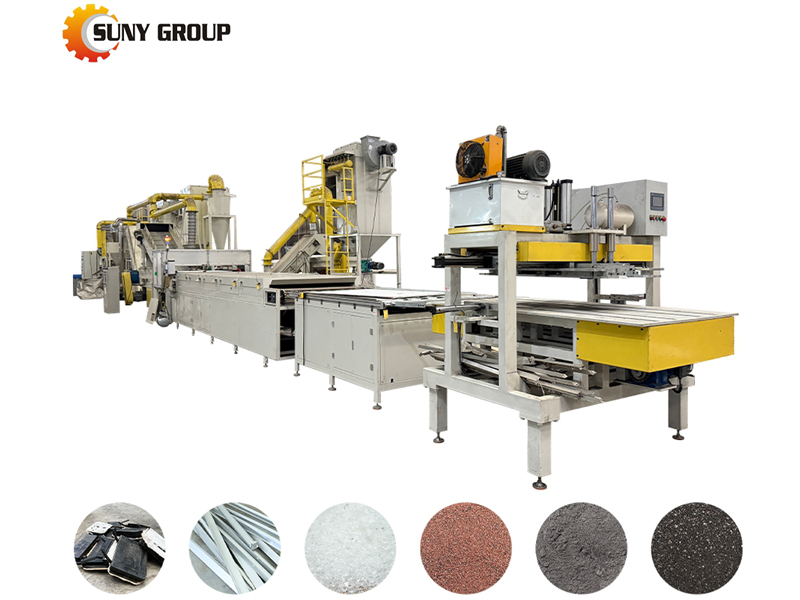
Photovoltaic Module Sorting and Recycling Facility
2. What Materials Can Be Recovered from Waste PV Panels?
A typical crystalline silicon photovoltaic panel consists of several valuable materials:
- Glass: The main component, which can be recycled for glass manufacturing.
- Aluminum: Mainly found in the panel frame and can be remelted into aluminum ingots.
- Silicon: Recovered from solar cells for further purification and reuse.
- Copper: Found in cables, ribbons, and electrical connections.
- Silver: Used in solar cell conductive contacts and can be recovered through specialized treatment.
- Plastic Materials: EVA encapsulant and backsheets can be separated and treated.
Thin-film panels require different recovery technologies to extract semiconductor materials such as cadmium, tellurium, and indium.
3. What Equipment Does a Photovoltaic Module Sorting and Recycling Facility Include?
A complete photovoltaic module recycling facility generally consists of:
- PV panel feeding and conveying system
- Manual or automatic sorting equipment
- Aluminum frame removal machine
- Junction box and cable removal machine
- Glass separation and delamination machine
- Solar panel crusher and shredder
- Vibrating screening machine
- Air separator and magnetic separator
- Electrostatic separation system
- Dust collection and wastewater treatment systems
The equipment configuration depends on panel types, processing capacity, and the required recovery efficiency.
4. How Does the Photovoltaic Module Recycling Process Work?
An integrated photovoltaic module sorting and recycling facility generally follows these steps:
Step 1: Collection and Sorting
Waste solar panels are collected and inspected. Operators classify them according to module technology, size, condition, and material structure. Reusable panels can be evaluated separately for second-life applications.
Step 2: Aluminum Frame and Junction Box Removal
The aluminum frame, junction box, and connecting cables are removed using specialized dismantling equipment. Aluminum and copper are collected for further recycling.
Step 3: Glass Separation
The laminated glass is separated from the solar cells through mechanical, thermal, or chemical delamination technologies. The selected method depends on the required glass quality and recovery targets.
Step 4: Crushing and Material Separation
The remaining materials are processed by crushing, shredding, and screening equipment. Air separation and electrostatic separation help separate glass, silicon-rich particles, metals, and plastic fractions.
Step 5: Material Recovery and Purification
Recovered silicon and valuable metals, including silver and copper, undergo further purification. Thin-film semiconductor materials require dedicated chemical recovery and treatment systems.
5. What Are the Advantages of a Photovoltaic Module Recycling Facility?
- High Resource Utilization: Recovers valuable glass, aluminum, silicon, copper, and other materials.
- Automated Processing: Reduces manual labor and improves production efficiency.
- Flexible Configuration: Suitable for different photovoltaic module types and processing capacities.
- Environmental Protection: Integrated dust collection, wastewater treatment, and residue management reduce environmental risks.
- Economic Benefits: Converts end-of-life solar panels into reusable secondary raw materials.
Photovoltaic module sorting and recycling facility provides an effective solution for processing end-of-life solar panels. By integrating sorting, dismantling, glass separation, crushing, screening, and material recovery technologies, recycling businesses can improve resource utilization and reduce solar waste. Choosing the right photovoltaic panel recycling equipment is essential for building an efficient and environmentally responsible recycling
Next: