


PV Solar Panel Recycling Machines
As global solar energy installations continue to grow rapidly, photovoltaic (PV) solar panel waste is also increasing worldwide. Most solar panels have a service life of 20–30 years, and millions of panels are expected to reach end-of-life in the coming years. This has created strong demand for efficient PV solar panel recycling machines and advanced recycling solutions. According to recent industry reports, the global solar panel recycling market is growing quickly due to stricter environmental regulations, rising renewable energy adoption, and the increasing value of recoverable materials such as glass, aluminum, silicon, copper, and silver.
Global Trends in Solar Panel Recycling
The solar recycling industry is becoming one of the fastest-growing sectors in renewable energy recycling.
Key Global Recycling Trends
- Europe currently leads the global solar panel recycling market
- Asia-Pacific is becoming the fastest-growing recycling region
- More countries are introducing PV waste management regulations
- Automated recycling systems are replacing manual dismantling
- High-purity material recovery technology is rapidly improving
Recent research also shows that mechanical recycling technology currently dominates the market because of its lower cost and scalability.
The rapid global expansion of solar energy installations is expected to create massive future recycling demand. Renewable energy growth and increasing PV installations are driving long-term recycling opportunities worldwide.
What Are PV Solar Panel Recycling Machines?
PV solar panel recycling machines are specialized systems designed to separate valuable materials from waste photovoltaic panels through dismantling, crushing, grinding, and separation technologies.
These recycling systems are suitable for processing:
- Monocrystalline solar panels
- Polycrystalline solar panels
- Thin-film solar panels
- Damaged or defective PV modules
- End-of-life solar panels
Modern recycling equipment focuses on maximizing recovery rates while reducing environmental pollution.
Latest Solar Panel Recycling Technology
Advanced PV recycling systems now combine mechanical, thermal, and intelligent separation technologies.
1. Mechanical Recycling Technology
Mechanical recycling mainly includes:
- Crushing
- Shredding
- Grinding
- Airflow separation
- Vibrating separation
This method is highly efficient for recovering:
- Aluminum frames
- Glass
- Copper
- Plastic materials
Mechanical recycling currently accounts for the largest share of the recycling market.
2. Thermal Separation Technology
Thermal treatment removes EVA adhesive layers from solar panels through controlled heating processes, improving silicon and metal recovery efficiency.
3. Intelligent Automatic Separation Systems
New automated recycling lines use:
- PLC intelligent control systems
- AI sorting systems
- Dust-free processing technology
- High-efficiency airflow separation
Some modern systems can achieve recovery rates above 99%.
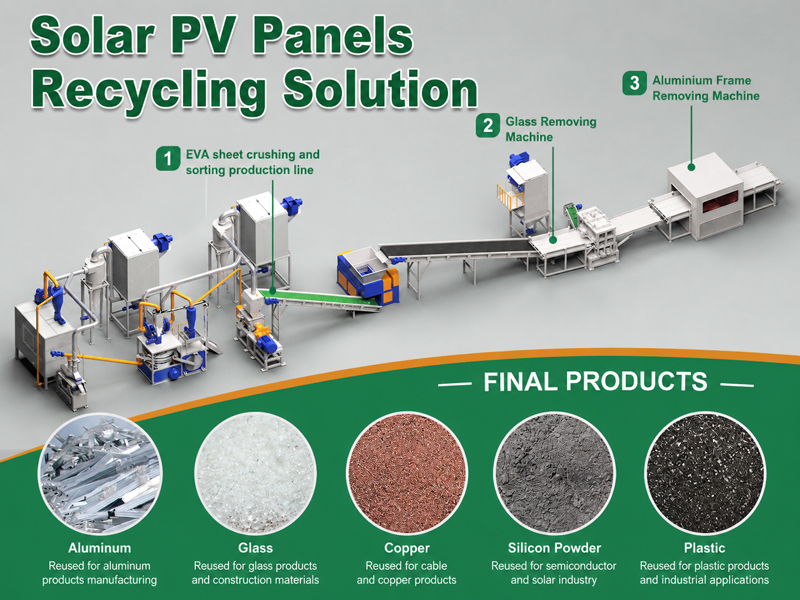
Complete PV Solar Panel Recycling Process
Step 1: Aluminum Frame Removal
The outer aluminum frame is automatically dismantled and collected for recycling.
Step 2: Glass Separation
The tempered glass layer is separated and crushed into reusable glass particles.
Step 3: Crushing and Grinding
The remaining panel materials enter the crusher and grinding system for size reduction.
Step 4: Thermal Treatment
Heating systems remove EVA adhesive layers to improve material liberation.
Step 5: Airflow and Gravity Separation
Copper, silicon powder, plastics, and metal particles are separated through airflow and gravity sorting equipment.
Step 6: Dust Collection and Environmental Treatment
Dust removal systems ensure environmentally friendly production and cleaner workshop conditions.
Main Features of PV Solar Panel Recycling Machines
Modern recycling equipment offers several important advantages:
- Fully automatic operation
- High material recovery efficiency
- Environmentally friendly processing
- Energy-saving design
- Stable continuous production
- Intelligent control system
- Low labor cost
- High-purity final materials
These systems are designed for both medium-scale and large industrial recycling plants.
Final Recovered Materials
After recycling, several valuable materials can be recovered.
Recycled Glass
Glass accounts for most of the panel weight and can be reused in:
- Construction materials
- Glass manufacturing
- Concrete production
Aluminum
Recovered aluminum frames are widely used in metal recycling industries.
Copper
Copper materials can be reused in:
- Cable manufacturing
- Electrical equipment production
- Metal smelting industries
Silicon Powder
Purified silicon can be reused for:
- Solar industry applications
- Semiconductor materials
- Industrial manufacturing
Silver and Precious Metals
Some advanced systems can recover valuable silver materials from photovoltaic cells. Rising silver prices are also increasing the economic value of solar panel recycling.
PV solar panel recycling machines are becoming increasingly important as the global solar industry continues to expand. Advanced recycling technologies now allow efficient recovery of glass, aluminum, copper, silicon, and precious metals from end-of-life solar panels. With growing environmental regulations and rising renewable energy demand, solar panel recycling will become a major global industry in the future. Choosing advanced automatic recycling equipment can help companies improve recovery efficiency, reduce environmental pollution, and maximize recycling profits.