


Photovoltaic (PV) Module Recycling Facility
Date:2026-06-18 Categories:Blog
Photovoltaic (PV) Module Recycling Facility is an advanced industrial system designed to process end-of-life solar panels and recover valuable materials such as aluminum, glass, silicon, copper, and silver. As global solar energy installations continue to expand, large-scale PV waste is expected to grow significantly, making recycling facilities essential for sustainable energy development and circular economy goals.
Types of Photovoltaic (PV) Modules
PV modules are mainly classified into the following categories:
1. Crystalline Silicon Modules
- Monocrystalline silicon (high efficiency, long lifespan)
- Polycrystalline silicon (lower cost, widely used)
- Most common type in global solar installations
2. Thin-Film Modules
- CdTe (Cadmium Telluride) modules
- CIGS (Copper Indium Gallium Selenide) modules
- Amorphous silicon modules
- Lightweight and flexible, but lower efficiency
3. Advanced PV Modules
- Bifacial solar panels
- Building-integrated photovoltaics (BIPV)
- High-efficiency PERC and TOPCon modules
PV Recycling Facility Introduction
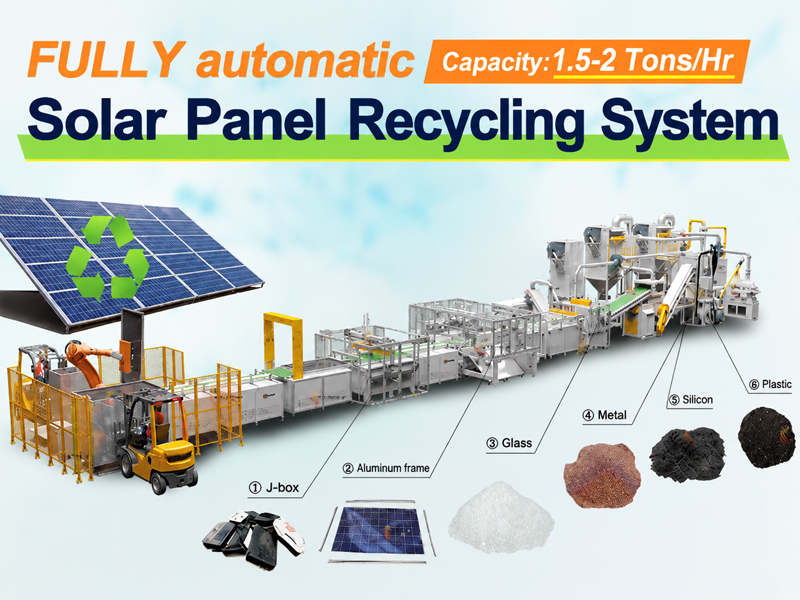
PV recycling facility is a complete processing system that safely dismantles and separates solar panel materials for resource recovery. The facility typically includes:
- PV module dismantling system
- Frame and junction box removal unit
- Glass separation system
- Thermal or chemical delamination unit
- Crushing and grinding equipment
- Metal and material separation system
The goal is to maximize material recovery while minimizing environmental impact.
Working Process of PV Module Recycling
The recycling process generally follows these key steps:
1. Manual or Mechanical Dismantling
Aluminum frames and junction boxes are removed from solar panels.
2. Glass Separation
Glass is separated using mechanical peeling or thermal treatment, accounting for the largest material portion.
3. Delamination Process
Thermal or chemical methods are used to separate EVA (ethylene vinyl acetate) and silicon layers.
4. Crushing and Grinding
Remaining PV materials are crushed into fine particles for further separation.
5. Metal Recovery
Advanced separation techniques such as electrostatic separation, flotation, and chemical extraction are used to recover metals.
Recovered Materials and Their Value
PV module recycling produces several valuable materials with strong industrial demand:
1. Aluminum
- From module frames
- High recycling purity and reuse in construction and transportation
2. Glass
- Accounts for about 70–75% of module weight
- Reused in fiberglass, construction materials, and new glass products
3. Silicon
- Recovered from solar cells
- Can be refined for semiconductor and new PV production
4. Copper
- Found in wiring and electrical contacts
- High conductivity makes it valuable for electrical industries
5. Silver
- Used in cell metallization
- High market value and limited global supply
6. Rare Metals (in thin-film modules)
- Indium, gallium, tellurium, cadmium
- Used in advanced electronics and photovoltaic manufacturing
Photovoltaic (PV) Module Recycling Facility plays a critical role in managing solar panel waste and recovering valuable resources. By processing different types of PV modules such as crystalline silicon and thin-film panels, the facility efficiently separates glass, aluminum, silicon, copper, and precious metals like silver. With advanced recycling technology and growing global demand for clean energy, PV recycling is becoming an essential industry for sustainable development and resource recovery.