


PV Module Recycling Machine
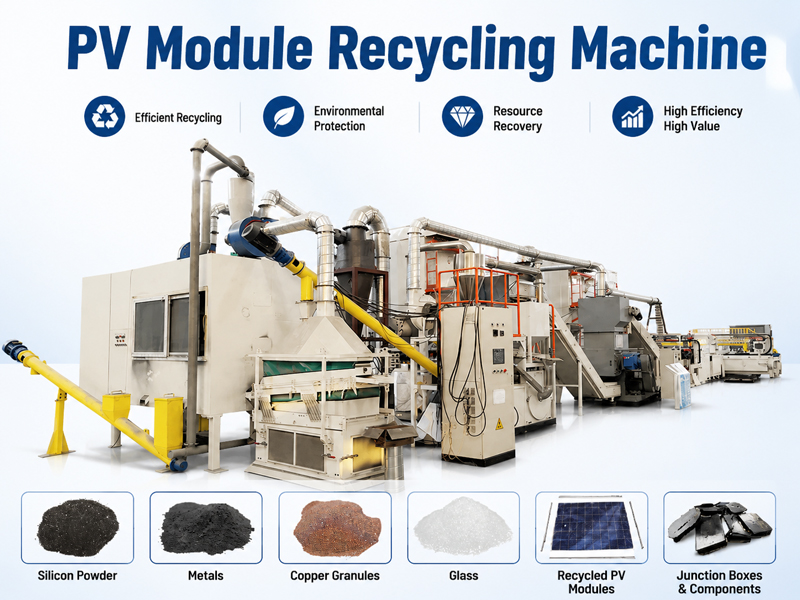
With the rapid growth of solar energy worldwide, the number of retired and damaged photovoltaic (PV) modules is increasing significantly. A PV Module Recycling Machine is designed to recover valuable materials from waste solar panels, reduce environmental pollution, and improve resource utilization. Through advanced dismantling, crushing, separation, and purification technologies, PV recycling machines can efficiently recover glass, aluminum, silicon, copper, silver, and other valuable materials from different types of solar modules. Building a suitable PV module recycling system has become an important investment opportunity in the renewable energy recycling industry.
1. Types of PV Modules and Their Recycling Value
There are several common types of PV modules used in the solar industry, and each type has different structures and recycling values.
1. Monocrystalline Silicon PV Modules
Monocrystalline silicon modules are widely used because of their high efficiency and long service life. They contain valuable materials such as:
- Glass: Around 70%-75% of the module weight, which can be recycled into new glass products.
- Aluminum frame: Can be recycled and reused in metal industries.
- Silicon wafers: Can be recovered and processed into new solar cells or industrial silicon materials.
- Silver and copper: Valuable metals that can be extracted for reuse.
Due to their high silicon and metal content, monocrystalline PV modules have significant recycling value.
2. Polycrystalline Silicon PV Modules
Polycrystalline modules are another widely used solar panel type. Although their efficiency is slightly lower than monocrystalline modules, they contain similar recyclable materials, including glass, aluminum, silicon, copper, and precious metals. Recycling these modules helps reduce raw material consumption and lowers the environmental impact of solar waste.
3. Thin-Film PV Modules
Thin-film modules use different semiconductor materials, such as cadmium telluride (CdTe) and copper indium gallium selenide (CIGS). Compared with crystalline silicon panels, thin-film modules have less glass and silicon but contain valuable semiconductor materials. Specialized recycling technology is required to recover metals and prevent harmful substances from entering the environment.
2. PV Module Recycling Machine Introduction
A complete PV Module Recycling Machine usually includes several types of equipment working together to achieve efficient material recovery.
Main Equipment Configuration:
1. PV Panel Dismantling Machine
The dismantling machine removes aluminum frames, junction boxes, and cables from waste solar panels. This process improves recycling efficiency and prepares modules for further treatment.
2. Glass Separator
The glass separator uses mechanical separation technology to remove the glass layer from solar panels. Since glass accounts for the largest proportion of PV modules, efficient glass recovery greatly improves recycling profits.
3. Crusher and Shredder Machine
After dismantling, PV panels are crushed into smaller pieces by shredders and crushers. The crushing process releases embedded materials such as silicon cells, copper wires, and metals.
4. Air Separator and Magnetic Separator
These machines separate different materials based on physical properties. Air separators remove lightweight materials such as plastics, while magnetic separators extract ferrous metals.
5. Eddy Current Separator and Sorting System
Eddy current separators are used to recover non-ferrous metals such as aluminum and copper. Advanced sorting systems improve the purity of recovered materials.
3. How to Configure a PV Module Recycling Line
The configuration of a PV Module Recycling Machine depends on processing capacity, investment budget, and final recycling requirements.
A basic PV recycling line may include:
- Feeding system
- Frame dismantling machine
- Glass removing machine
- Shredder and crusher
- Dust collection system
- Magnetic separator
- Air separator
- Metal sorting system
- Silicon powder recovery equipment
For small recycling projects, a semi-automatic system can process several hundred kilograms of PV panels per hour. For large-scale recycling plants, a fully automatic production line with intelligent sorting and high-capacity processing equipment is recommended.
When selecting equipment, companies should consider:
- Processing capacity: Choose machines according to daily PV waste volume.
- Material recovery rate: Higher recovery efficiency increases economic benefits.
- Energy consumption: Low-energy equipment reduces operating costs.
- Automation level: Automatic systems improve production efficiency and safety.
- Environmental protection: Dust collection and waste treatment systems are necessary.
4. Applications of Recycled PV Materials
After processing through a PV Module Recycling Machine, recovered materials can be reused in many industries.
Glass Applications
Recovered photovoltaic glass can be used for:
- New glass production
- Construction materials
- Fiberglass manufacturing
Aluminum Applications
Recycled aluminum frames can be applied in:
- Automotive parts
- Building materials
- New solar panel frames
Silicon Applications
Recovered silicon materials can be used for:
- New photovoltaic production
- Semiconductor industries
- Industrial silicon products
Copper and Silver Applications
Recovered metals can be reused in:
- Electrical equipment
- Electronic products
- Metal manufacturing industries
PV Module Recycling Machine provides an effective solution for handling increasing solar panel waste and recovering valuable resources. By processing different PV modules, including monocrystalline, polycrystalline, and thin-film solar panels, recycling plants can recover glass, aluminum, silicon, copper, and other materials with high economic value. A properly configured PV recycling line not only reduces environmental pollution but also creates new business opportunities in the renewable energy recycling market. With the continuous expansion of solar power, PV module recycling technology will become increasingly important for achieving a sustainable circular economy.