


Solar Panel Recycling Equipment for Photovoltaic Waste
As the global adoption of solar energy accelerates, the number of end-of-life photovoltaic (PV) panels is rapidly increasing. Solar panel recycling equipment for photovoltaic waste has become a key solution to address environmental concerns and unlock valuable resources. This article explores why PV recycling is gaining attention, its economic value, equipment configuration, recycling methods, and material applications.
1. Why Solar Panel Recycling Is Gaining Attention
The surge in solar installations over the past decades has created a future wave of PV waste. Several factors are driving the focus on recycling:
- Environmental Regulations: Governments are enforcing stricter policies on electronic and hazardous waste disposal.
- Large Volume of Waste: Millions of solar panels will reach end-of-life in the coming years.
- Resource Recovery Needs: PV panels contain valuable and reusable materials.
- Sustainability Goals: Recycling supports the circular economy and reduces landfill pressure.
2. Economic Value of Photovoltaic Panel Recycling
Recycling photovoltaic panels offers significant financial returns due to the recovery of valuable materials.
Key Recoverable Materials:
- Glass (accounts for ~70% of panel weight)
- Aluminum (frame)
- Silicon (solar cells)
- Copper (wiring)
- Silver (conductive paste)
Economic Benefits:
- High Material Recovery Rate: Glass and aluminum can be recycled efficiently.
- Precious Metal Value: Silver and silicon provide high profit margins.
- Reduced Production Costs: Recovered materials can re-enter manufacturing.
- Growing Recycling Market: Increasing demand for sustainable materials boosts profitability.
3. Solar Panel Recycling Equipment and Line Configuration
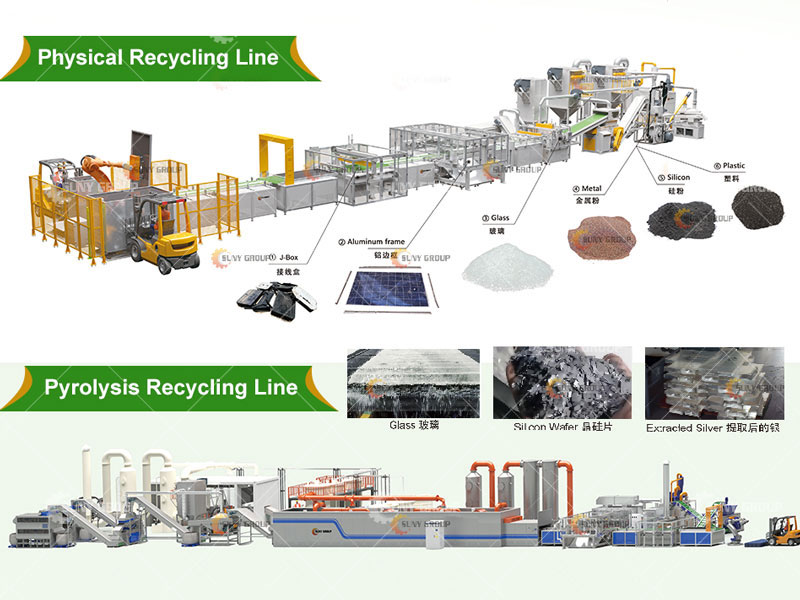
A complete solar panel recycling production line typically includes the following equipment:
Pre-Treatment Equipment:
- Frame removal machine (separates aluminum frame)
- Junction box removal system
- Glass removal device
Crushing and Separation:
- Shredder or crusher (breaks panels into smaller pieces)
- Hammer mill (further size reduction)
- Vibrating screen (classifies materials)
Material Separation:
- Air separator (light and heavy material separation)
- Magnetic separator (removes metals)
- Electrostatic separator (separates fine particles like silicon and metals)
Environmental Protection Systems:
- Dust collection system
- Waste gas treatment unit
This configuration ensures efficient, safe, and environmentally friendly recycling.
4. Physical Recycling vs. Pyrolysis
There are two main methods for photovoltaic panel recycling:
Physical Recycling:
- Process: Mechanical crushing and separation
- Advantages:
- Lower cost
- No high-temperature requirements
- Environmentally friendly
- Disadvantages:
- Lower purity of recovered silicon and silver
Pyrolysis (Thermal Recycling):
- Process: High-temperature treatment to decompose EVA layers
- Advantages:
- Higher recovery purity (especially silicon and silver)
- Better separation efficiency
- Disadvantages:
- Higher energy consumption
- Requires advanced gas treatment systems
Both methods are often combined in modern recycling plants for optimal results.
5. Applications of Recycled Materials
Recovered materials from solar panels have wide applications across industries:
- Glass: Used in construction, fiberglass, and new solar panels
- Aluminum: Reused in automotive and building industries
- Silicon: Refined for semiconductor and solar cell production
- Copper: Applied in electrical wiring and electronics
- Silver: Reused in electronics and conductive materials
These applications ensure that recycled materials retain strong market value.
Solar panel recycling equipment for photovoltaic waste plays a vital role in sustainable energy development. With increasing environmental awareness, strong economic returns, and advanced recycling technologies, investing in PV recycling systems is a strategic move. By combining physical and thermal processes, businesses can maximize recovery efficiency and contribute to a greener, circular economy.