


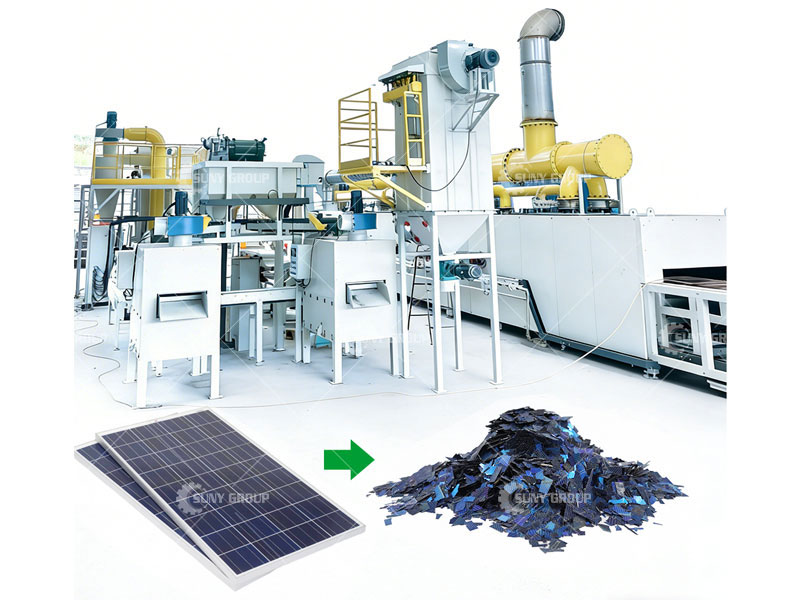
Solar panel crushing plant
Solar panel crushing plant is an essential solution for recycling waste photovoltaic (PV) modules. As global solar installations continue to grow, the number of end-of-life and damaged solar panels is increasing rapidly. Efficient crushing and material separation systems are now critical for sustainable solar panel recycling and resource recovery.
Why Solar Panel Crushing Plants Are in High Demand
The average service life of solar panels is 25–30 years. Early solar farms are now being decommissioned, creating large volumes of solar panel waste. A solar panel crushing plant enables recycling companies to process this waste efficiently while complying with environmental regulations and reducing landfill pressure.
Key Components of a Solar Panel Crushing Plant
A complete solar panel crushing plant usually includes:
-
Feeding and conveying system
-
Primary and secondary crushing units
-
Magnetic separation equipment
-
Air separation system
-
Dust collection and filtration system
Each component is designed to ensure stable operation, high throughput, and accurate material separation.
Working Principle of Solar Panel Crushing Plant
The working principle of a solar panel crushing plant is based on mechanical size reduction and physical separation. After pre-treatment, solar panels enter the crushing system, where they are broken into smaller particles. Metals and non-metallic materials are then separated using magnetic force, airflow, and screening technology.
Solar Panel Crushing Process Step by Step
-
Removal of aluminum frames and junction boxes
-
Feeding panels into the crusher for size reduction
-
Screening crushed materials by particle size
-
Magnetic separation of ferrous metals
-
Air separation of light and heavy materials
This process ensures efficient recovery of valuable components while minimizing material loss.
Materials Recovered from Solar Panel Crushing
A solar panel crushing plant can recover multiple valuable materials, including:
-
Tempered glass
-
Aluminum
-
Copper
-
Silicon-based particles
These recycled materials can be reused in construction, metal smelting, electrical manufacturing, and industrial applications.
Advantages of Solar Panel Crushing Plant
Compared with manual dismantling, a solar panel crushing plant offers:
-
High automation and stable performance
-
Lower labor costs
-
Higher processing efficiency
-
Consistent material quality
-
Scalable capacity for industrial recycling plants
These advantages make solar panel crushing plants ideal for large-scale PV recycling projects.
Environmental and Economic Benefits
Using a solar panel crushing plant helps reduce environmental pollution, conserve natural resources, and lower carbon emissions. At the same time, recovered materials generate additional income, improving the profitability of solar panel recycling businesses.
Applications of Recycled Solar Panel Materials
Recycled glass can be used in construction and insulation materials, aluminum can be remelted and reused, copper is suitable for electrical products, and silicon materials can be further processed for industrial reuse.
How to Choose the Right Solar Panel Crushing Plant
When selecting a solar panel crushing plant, factors such as processing capacity, automation level, energy consumption, separation efficiency, and after-sales service should be carefully evaluated. Choosing the right system ensures long-term reliability and maximum return on investment.
Solar panel crushing plant is a key solution for handling the growing volume of solar panel waste. With efficient crushing technology and high material recovery rates, it supports sustainable development and creates new economic opportunities in the renewable energy recycling industry.