


PV Panel Recycling Plant
With the rapid growth of the global renewable energy industry, photovoltaic (PV) power generation has entered a large-scale development stage. Millions of solar panels have been installed over the past 20–30 years, and a significant number of these PV modules are now approaching the end of their service life. According to industry forecasts, global PV waste will increase sharply in the coming decades.
As a result, the PV panel recycling plant has become a critical solution to address environmental pressure, resource shortages, and sustainable development goals. Recycling discarded PV panels not only prevents landfill pollution but also supports the circular economy of the solar industry.
Recycling Value of a PV Panel Recycling Plant
A modern PV panel recycling plant focuses on recovering high-value materials from waste solar panels. Typical crystalline silicon PV modules contain a large proportion of reusable resources.
Key recycling values include:
-
Glass recovery: Accounts for over 70% of the panel weight and can be reused in construction or glass manufacturing.
-
Aluminum frame recycling: Aluminum has high recycling efficiency and strong market demand.
-
Silicon material recovery: Recycled silicon can be reused in metallurgical or photovoltaic applications.
-
Copper and silver extraction: Conductive metals provide additional economic value.
-
Plastic and polymer separation: Supports secondary processing or energy recovery.
By operating a PV panel recycling plant, investors can benefit from both environmental compliance and long-term economic returns.
Configuration of a PV Panel Recycling Plant
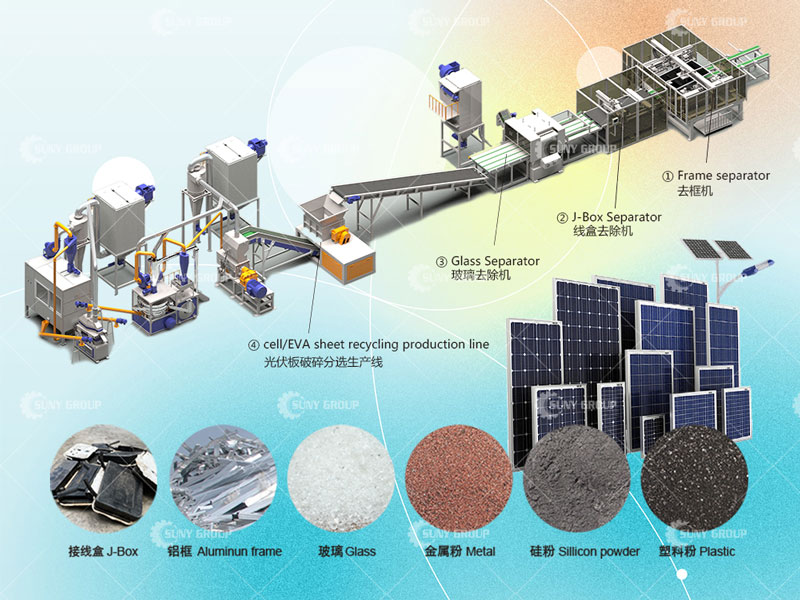
A complete PV panel recycling plant is usually designed as an automated or semi-automated processing line. The configuration may vary depending on capacity, panel type, and recycling depth, but a standard recycling line generally includes the following equipment:
-
PV Panel Frame Removal Machine
Automatically separates aluminum frames from the PV panels. -
Junction Box Removal System
Detaches the junction box to recover copper cables and connectors. -
Crushing and Shredding Equipment
Reduces the size of PV panels to facilitate further separation. -
Grinding and Liberation System
Ensures effective material liberation of glass, silicon, and metals. -
Physical Separation Units
-
Magnetic separators for ferrous metals
-
Eddy current separators for non-ferrous metals
-
Air classifiers for lightweight materials
-
-
Dust Collection and Environmental Protection System
Ensures clean, compliant, and safe operation of the recycling plant.
An efficient PV panel recycling plant is characterized by high recovery rates, low energy consumption, and stable output quality.
Applications of Recycled Materials
Materials recovered from a PV panel recycling plant have broad downstream applications across multiple industries:
-
Recycled glass: Used in insulation materials, glass fiber products, or building materials.
-
Recovered aluminum: Reprocessed into aluminum profiles, automotive parts, or construction materials.
-
Silicon powder: Applied in metallurgy, chemical industries, or re-refined for photovoltaic use.
-
Copper and precious metals: Used in electrical cables, electronics, and metal smelting.
-
Plastic residues: Converted into fuel, pellets, or secondary plastic products.
These applications significantly improve resource utilization efficiency and reduce reliance on virgin raw materials.
As global solar installations continue to grow, the demand for a reliable and efficient PV panel recycling plant will increase rapidly. With strong recycling value, mature line configurations, and wide applications of recycled materials, PV panel recycling is becoming an essential part of the renewable energy industry chain. Investing in a PV panel recycling plant not only meets environmental regulations but also creates sustainable economic opportunities in the green energy era.