


Automatic Solar Panel Recycling Equipment Price
Automatic solar panel recycling equipment price is a critical consideration for recycling companies, waste management firms, and investors entering the photovoltaic (PV) recycling industry. As global solar installations grow, demand for efficient and fully automated recycling solutions continues to rise.
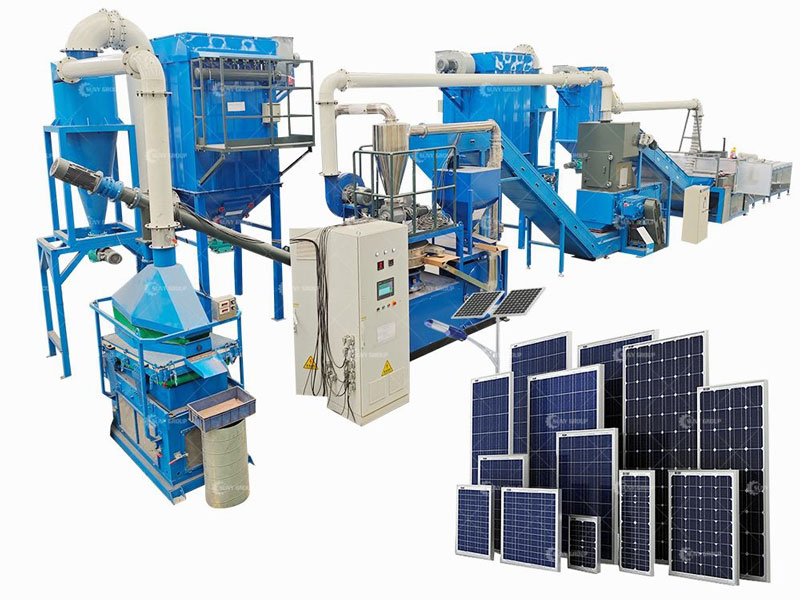
Equipment introduction: how automatic solar panel recycling systems work
Automatic solar panel recycling equipment is designed to process end-of-life photovoltaic modules from feeding to final material separation with minimal manual operation. A standard system includes automatic feeding conveyors, frame removal units, crushing or dismantling machines, glass separation modules, metal sorting devices, and intelligent dust collection systems. Advanced lines also integrate PLC control systems to ensure stable operation and consistent output quality. These machines can handle different panel sizes while maintaining high processing efficiency.
Price analysis: key factors affecting equipment cost
The automatic solar panel recycling equipment price varies significantly based on several technical and commercial factors:
-
Processing capacity: Higher throughput systems require stronger structures and more powerful drives, increasing cost.
-
Automation level: Fully automatic recycling lines cost more than semi-automatic solutions but reduce long-term labor expenses.
-
Separation technology: Equipment using high-precision sorting or thermal delamination generally has a higher initial price.
-
Material recovery rate: Systems designed for higher purity output require more advanced components.
-
Customization and service: Installation, training, and after-sales support influence total investment.
In general, small-scale automatic equipment is suitable for pilot projects, while large industrial lines represent a higher investment but offer better unit economics over time.
Advantages of fully automatic solar panel recycling equipment
Choosing a fully automatic solution offers clear operational and economic benefits:
-
Labor cost reduction: Automated feeding and separation reduce reliance on manual labor.
-
Stable processing efficiency: Continuous operation improves daily output and consistency.
-
Higher safety standards: Enclosed systems limit dust and manual handling risks.
-
Improved material purity: Accurate separation increases the resale value of recycled materials.
-
Scalable operation: Modular designs allow future capacity expansion.
These advantages make full automation a preferred option for long-term PV recycling projects.
Value of recycled materials after processing
Recycled outputs are the foundation of return on investment for solar panel recycling plants:
-
Glass: Represents the largest percentage of a solar panel and can be reused in construction or glass manufacturing.
-
Aluminum frames: Easily recycled with stable market demand.
-
Copper and wiring: High market value and strong demand in the metal recycling sector.
-
Silicon cells: Can be further refined for industrial reuse.
-
Precious metals: Small quantities of silver contribute significantly to overall material value.
Conclusion
Evaluating automatic solar panel recycling equipment price requires balancing initial investment with operational efficiency and recovered material value. Fully automatic systems deliver higher productivity, better safety, and stronger long-term profitability, making them a strategic choice for modern solar panel recycling operations.